
Bubble Wrap Boy’s Life Transformed Through Complex Neurofibromatosis Surgery: A Rare Reconstructive Plastic Surgery Case
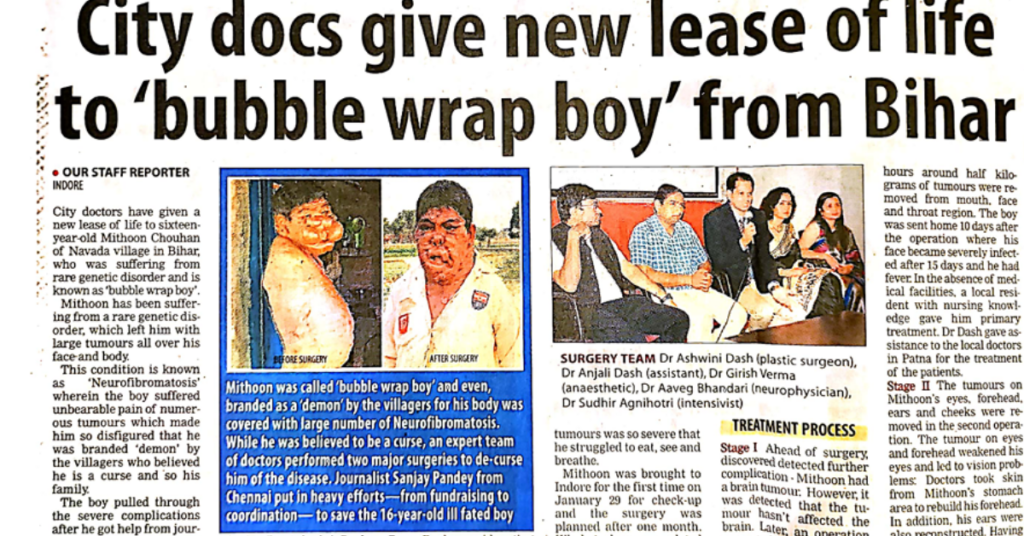
Patient's Initial Condition
Symptoms / Health Concerns
A 16-year-old boy from Nawada village, Bihar, was suffering from Neurofibromatosis (NF), a rare genetic disorder that caused hundreds of large tumours to develop across his face, mouth, neck, eyes, forehead, ears, and other parts of his body. The disease progressively affected his facial appearance, vision, breathing, eating, and overall quality of life.
The extensive facial deformities resulted in severe physical limitations as well as emotional and social challenges. Due to a lack of awareness about the condition, he was often isolated within his community and struggled to live a normal childhood.
Previous Treatments
The patient had not received definitive surgical treatment before being referred to Dr. Ashwini Dash. Following a fundraising initiative and coordinated medical support, he was brought to Indore for comprehensive evaluation and advanced reconstructive surgery.
Diagnosis
Final Diagnosis
Severe Neurofibromatosis (NF) with extensive craniofacial neurofibromas involving the mouth, face, throat, forehead, eyelids, ears, and surrounding facial structures, causing significant functional impairment and facial deformity.
Tests / Scans / Investigations
Clinical examination
• CT Scan
• MRI Scan
• Pre-operative evaluation
• Neurological assessment
During the pre-operative workup, doctors also identified a brain tumour. After detailed imaging and neurological evaluation, it was confirmed that the tumour had not involved the brain tissue, allowing the reconstructive procedures to proceed safely.
Treatment Details
Considering the complexity of the disease and the patient's overall condition, Dr. Ashwini Dash and his multidisciplinary surgical team planned a staged reconstructive plastic surgery approach.
Stage 1: Functional Tumour Removal
The first surgery focused on removing the large neurofibromas affecting the mouth, face, and throat, which were significantly interfering with breathing, eating, and facial movement.
The procedure lasted approximately four hours, during which nearly 500 grams of tumour tissue were carefully removed while preserving critical nerves and surrounding anatomical structures.
Following surgery, the patient recovered well and was discharged after ten days. When a postoperative infection developed after returning home, Dr. Dash continued to guide the treating doctors remotely, ensuring timely medical management despite limited healthcare facilities in the patient's hometown.
Stage 2: Advanced Facial Reconstruction
After recovery from the first operation, a second reconstructive surgery was performed to remove tumours involving the eyelids, forehead, ears, and cheeks.
Because tumour growth had weakened the forehead tissues, skin was harvested from the patient's abdominal region and used to reconstruct the forehead. Simultaneously, both ears were reconstructed to restore facial symmetry and improve overall appearance.
The staged surgical approach successfully addressed both functional limitations and cosmetic deformities while preserving vital facial structures.
Duration: Approximately 4 months, including evaluation, staged surgeries, postoperative recovery, and follow-up.
Advanced Techniques Used
Advanced Craniofacial Reconstructive Plastic Surgery
Multi-stage Neurofibromatosis Tumour Excision
• Forehead Reconstruction Using Autologous Skin Grafting
• Ear Reconstruction
• Advanced Craniofacial Reconstructive Plastic Surgery
• Multi-stage Neurofibromatosis Tumour Excision
• Forehead Reconstruction Using Autologous Skin Grafting
• Ear Reconstruction
• Functional Facial Reconstruction
• Multidisciplinary Surgical Planning
• Functional Facial Reconstruction
• Multidisciplinary Surgical Planning
Results & Recovery
Patient Improvements
Following the successful staged reconstructive surgeries, the patient experienced life-changing improvements in both function and appearance.
• Large facial tumours were successfully removed.
• Significant improvement in breathing.
• Improved ability to eat comfortably.
• Better vision after removal of periocular tumours.
• Restoration of facial symmetry.
• Successful forehead and ear reconstruction.
• Improved confidence and psychological well-being.
• Marked enhancement in overall quality of life.
• Returned for follow-up with excellent postoperative recovery.
Final Outcome
The staged reconstructive surgeries successfully transformed the patient's facial function and appearance. The combination of meticulous surgical planning, multidisciplinary expertise, and comprehensive postoperative care enabled the patient to regain essential daily functions while dramatically improving his facial aesthetics and confidence.
Returned to Normal Activities: Yes
Case Highlights
What Makes This Case Unique
This case represents one of the most challenging examples of craniofacial Neurofibromatosis reconstruction, involving extensive facial tumours affecting multiple critical structures. Through meticulous planning and staged reconstructive plastic surgery, Dr. Ashwini Dash successfully restored both function and facial appearance in a patient whose condition had severely affected every aspect of daily life.
The extraordinary journey and successful outcome were later recognized internationally and featured in a 45-minute documentary broadcast by a UK television channel, highlighting the remarkable transformation achieved through advanced reconstructive surgery.
Complex / Rare Factors
The patient had an exceptionally severe presentation of Neurofibromatosis, involving widespread craniofacial tumours, functional impairment, associated brain tumour evaluation, complex facial reconstruction, and multiple high-risk surgical procedures. The estimated recovery success rate was approximately 50%, making this an exceptionally rare and technically demanding case.
Most Significant Benefit
Complete functional restoration through staged tumour removal and facial reconstruction, allowing the patient to breathe, eat, see more comfortably, regain facial balance, and experience a renewed quality of life.
Conclusion
This case demonstrates how advanced reconstructive plastic surgery for Neurofibromatosis can transform the lives of patients with complex craniofacial deformities. Through careful multidisciplinary planning, staged tumour excision, and sophisticated facial reconstruction, Dr. Ashwini Dash successfully restored both function and appearance in a case that many considered nearly impossible.
For patients living with Neurofibromatosis, complex facial tumours, congenital facial deformities, or challenging reconstructive needs, timely evaluation by an experienced reconstructive plastic surgeon can significantly improve functional outcomes, appearance, and long-term quality of life. This case reflects the importance of specialized surgical expertise, individualized treatment planning, and comprehensive postoperative care in managing rare and highly complex conditions.
https://www.youtube.com/watch?v=3Ayv0lOdXJw